SCHOOL
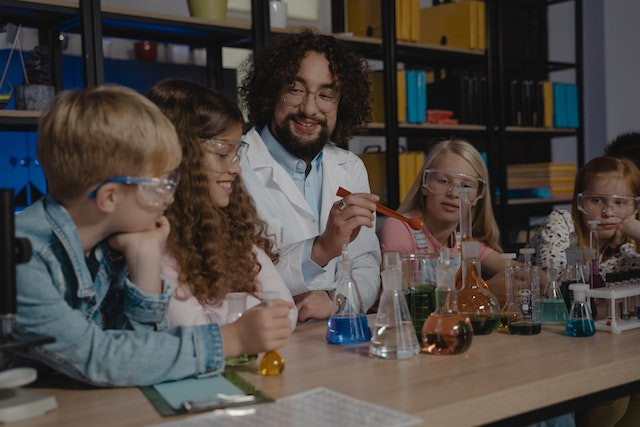
As a community-driven museum, we want to work with schools to create places of learning and exploring. Our team are on hand to give your students guided tours of the museum, teach them in our learning laboratory, and provide great video presentations that will excite and inspire them We focus on fulfilling the competance goals set by Kunnskapsdepartementet in the following courses Natural sciences Mathematics Arts & Crafts
Hands-on learning
Science museums offer a range of interactive exhibits and activities that allow young children to learn through exploration and experimentation, making it a fun and engaging way to learn about science.
Sparking curiosity
Science museums have exhibits that explore natural phenomena or the world around us in a way that can ignite a child's curiosity about science and the world.
Encouraging interest in STEM
By exposing children to science at an early age, science museums can help foster an interest in science, technology, engineering, and math (STEM) subjects, which can be valuable later in their education and careers.
Reinforcing classroom learning
Science museums can provide a way to reinforce topics taught in the classroom, giving students a chance to see real-world examples and applications of science concepts they have learned in school.
Connecting with scientific careers
Science museums can introduce middle school students to a range of STEM careers they may not have been aware of, inspiring them to consider a future in science.
Inspiring innovation
By showcasing cutting-edge technology and research, science museums can inspire middle school students to think creatively and innovatively, encouraging them to pursue science in their future studies and careers.
Exposure to advanced science
Science museums can provide secondary school students with exposure to more advanced scientific concepts and research, helping them to better understand complex topics.
Developing critical thinking
Science museums can encourage secondary school students to think critically and analytically, challenging them to apply scientific principles to real-world problems.
Preparing for higher education
Science museums can help prepare secondary school students for higher education in science by providing them with a taste of university-level research and introducing them to scientific careers that require advanced education.